Scratching
How do you stop a cat from scratching?
Declawing
Tendonectomy
Scratching
Scratching is one reason people do not wish to keep cats. This action tends to irritate people after a while. The long, graceful hooks of the cats nail can rip through almost any fabric. Their love for textures can cause them to go for walls, furniture, woodwork, beds, carpet, counters, dogs, and people.
But why do cats scratch? Even thou some may wish to believe it, cats do not scratch out of malicious urge. They have several natural, and useful reasons. On is the simple fact that scratching uses the scent glands located in their paws to mark their territory. Few of us comment when our dogs lift their legs everywhere, past the fact that it is irritating to walk five feet and stop. We consider it natural, and we accept it. The same is for the cat.
The next action of scratching is to shed the outer covering of the nail. As the cat's nail grows, a new inner nail grows. The subsequent outer nails move up, and the very outer layer which is now hard and brittle, splits. This needs to be shed and the cat scratches to remove this covering. If you have a scratching post, go over to it and notice all the white nail shaped flecks lying around. These are healthy signs for your feline.
The third reason is muscle tone. The claw is connected to the rest of the bone. The best way for the cat to flex and stretch its legs out is to scratch. This works its legs, chest, and entire upper body. A cat climbs, and these actions keep it loose and limber. Cats whom can no longer stretch often develop arthritis and leg problems, as well as pains, because they can no longer stretch out these muscles in the most natural of ways.
How do you stop a cat from scratching?
The first, and easiest way is to never let the cat enter a situation with out a scratching post. I ran off to Wal-Mart and got my guys a little scratching post they could sit on top of before they came home. They did not start to use it until they were about three months old. But they had it, and when there were the first signs of scratching, it was on that post.
They wake when they scratch. It is best to have scratching posts readily available. I've watched mine wake, stretch, and stroll over to finish stretching out. If the scratching post is to far away, they probably wont use it.
And again, the post should be near activity. Cats tend to like to know what's going on. If their scratching post is in the basement, and you are constantly on the third floor of the house, chances are, they won't use their post very much. If décor worries you, get one that matches the rest of the house. We have a white post in the corner. It's six feet tall and blends in with the wall. We've only had two guests see it before the cats were in it, or they sat down beside it.
Now, if a cat associates another area with its main place to be, it will often begin to scratch there. We had one kitten that was very sick, and she needed a lot of care. Mom kept her on the couch with her, and eventually, as she got better, she started to scratch the couch. There were several says to change this behavior:
1 - When she started to scratch, I moved her across the room onto the scratching post
2 - When she scratch I'd make some loud noise to startle her, and put her on the scratching post
3 - Water bottles work wonders, try one
4 - I also put clear tape on the areas she liked to scratch. Pissed her off, and she stopped because the desirable texture was no longer there.
5 - Removed her access while we were not at home from that area
If this seems like too much, maybe you don't need a pet. Pets need rules, supervision, and training just like kids do. Cats need it even more so because they are not responsive like dogs are. They enjoy our company but their entire life does not rotate around our emotions.
I did the above for a month, and we no longer have a scratching problem. This also works for older cats, not just kittens.
Declawing
Declawing seems like such a nice, simple option. You remove the cat's claws, and no more scratching worries. I wish it was that nice, but it's not. The first problem lays in the fact that animal nails are not connected as ours are. We have a nail bed located just under the layer of skin. People rip these out all the time and loose their nails. Because of that, we think every other creature has similar nails.
Oh, if it were true.
Img From StopDeclaw.com
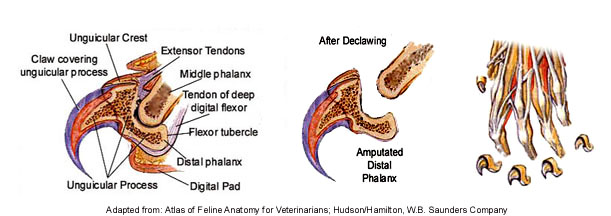
Cat's nails are attached to their bones. This gives the nails the anchor point to pull them up when they climb. The nail is not just attached to the bone; it grows out of the bone. The last digit of the cats toe is the nail bed. This is also the digit the cat walks on. Unlike dogs and humans, cat's walk on the last bone of their toe and use their claws as anchor points.
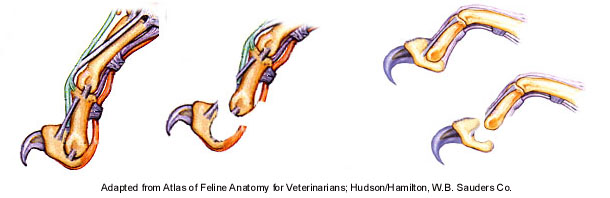
When you declaw, this bone is amputated. That is the only way that they can be sure the nail does not grow back. Cutting the nail off at the base just means it will grow back. If you remove anything less then the complete digit the nail will grow back deformed. The deformity will also cause pain for the toe.
So, they amputate the last digit of your cat's foot. Which would be like amputating the last digit of your fingers. Because cats not only walk on that digit, they also use their paws to grip and clasp things, and I've seen more then one cat carry something with one paw, you are removing all of these tings.
It is more then 'sore' for a couple of days. Amputation is a painful thing. It takes a long time for enough scar tissue to form around the end of the bone joint to pad it, and deaden the feelings. Declawed cats cannot normally use the litter box for the pain of it. The shredded newspaper needs little work from them to move it around, and hopefully they will not become scared of their litter box.
Cats are not meant to walk flat-footed, and many experience a lot of pain as they readjust themselves to walk. They often become clumsy and unsure of their own balance. They tend to fall a lot, or just not try to do things. Many bite when they would have clawed, because they are now defenseless.
That is what is being done to a cat when it is declawed.
Img From StopDeclaw.com
Tendonectomys
This is another option that has reached the surgical table in the last few years. Tendonectomies they simply cut the tendon that controls the nail. Now the cat has no ability to flex its nails, but it does not have the painful amputation of its digit. The nail must be cut regularly, and many people do not have this ability. If the nail is not cut, it will grow into the pad and become an infected nasty sore that will make your cat hate having its nails cut.
Also there is not yet research out on long-term effects. There is a worry that the inability to flex the toes may cause arthritis of the legs early. But the same goes for declawing.
Please make your choice wisely. Think beyond the issues of the moment. They are living creatures to, and declawing hurts a lot.